

JournTech
Publishing Board Guide
This guide was made from the help pages on 9 November 2026. The help centre has the latest version.
Help Press Ctrl+P to print it or save it as a PDF.
Role
Publishing Board
Approves ISBN requests before the application to the Ministry and sees the ISBN and legal deposit records.
Before the application to the Ministry of Culture and Tourism, a member of the publishing board approves the ISBN request that the production coordinator prepared, or sends it back with a reason. The person who prepared, edited or sent a request for approval cannot approve that request. The details of the rule are in Four-Eyes Principle.
In the panel you see the ISBN & legal deposit screen.
Permissions of this role
- See ISBN requests, printings and the legal deposit
- Approve ISBN requests (publishing board)
- See unpublished catalogue records
Screens and settings
Panel Search
Searching submissions, publications, people, users, pages and help topics at once with the search box in the panel's top bar.
The search box in the top bar searches many parts of the panel at once. When you type in the box and press Enter, the
Search screen opens and the results are grouped into sections. Turkish characters and upper and
lower case make no difference. For example, typing ışık also finds the title Işık Kirliliği.
The box appears for all roles other than Registered researcher and Reviewer. Which sections you see depends on your permissions.
Result sections
| Section | Permission needed to see it | Screen that opens all results |
|---|---|---|
| Submissions | See the submissions in scope (editor queue) | Editor queue |
| Publications | See unpublished catalogue records | Publications |
| People | Create and edit persons and institutions | People & institutions |
| Users | See user accounts | Users & roles |
| Pages | Edit pages, menus, banners, news, events and documents | Pages & policies |
| Help | No permission needed | The help centre's search |
Each section shows at most six results. If there are more, the See all link at the top of the section opens the search in that screen's list. Submission and publication results also show the type and the status.
When you press a help result, the topic opens in the help panel next to the screen, and you do not leave the screen you are working on.
When there are no results
Check the spelling or try a shorter phrase. If you are searching by submission number, type the whole number, for example JT-2026-00012.
How-to
Downloading Crossref XML
Downloading the Crossref XML file of a catalogue record or a journal issue for DOI registration, and the conditions the file needs.
To upload to Crossref by hand, you download the Crossref XML file of a record or of a journal issue. The file is made only for public records that have a DOI. If your institution's automatic DOI registration is on, records go to Crossref by themselves and you do not need this file.
The file of a record
- On the record's page, find the Record information card on the right.
- Press Download Crossref XML.
The button appears on article, book, book chapter and proceedings paper records. An article's file also carries the details of its journal and its published issue. An article in early view has no issue yet, and its file is made with the details of its journal only. The file of an article whose issue went back to draft carries no issue details.
A book's file carries all the book's ISBNs. A number obtained through an ISBN request is written as print or electronic, depending on the form of the request. A number typed into the catalogue by hand counts as print.
The file of an issue
- Open the issue's page.
- Press the Crossref XML button at the top of the page.
The issue's file contains every public article of the issue that has a valid DOI. Articles without a DOI are left out of the file. The file needs a published journal record and a published issue.
Conditions for the file
- The record must be published, archived or retracted.
- The record must have a DOI.
- If a DOI prefix is entered in the site settings, the DOI must start with that prefix.
- A thesis must have an author and the institution where it was written.
If a thesis's institution is not typed in but only linked to an institution record, the institution's name and ROR ID come from that record. Imported theses may be like this. If the institution record was deleted, the thesis's file is not made.
Crossref accepts only two-letter ISO 639-1 codes as languages. Ottoman Turkish has no such code. The file does not state the language of a record or a title in that language.
An article's file also contains its reference list. References that mention a DOI in their text are written with their DOIs. If the system administrator switches off the Crossref XML export feature, the file cannot be downloaded.
Sending records to Crossref automatically is explained in Automatic DOI Registration.
Screens and settings
Publications
The list of catalogue records with its search box, filters, columns, row menu and bulk action bar.
The Catalogue → Publications screen lists all draft, in-review and published records in the catalogue. Opening a new record, finding a record and applying the same action to several records all start here.
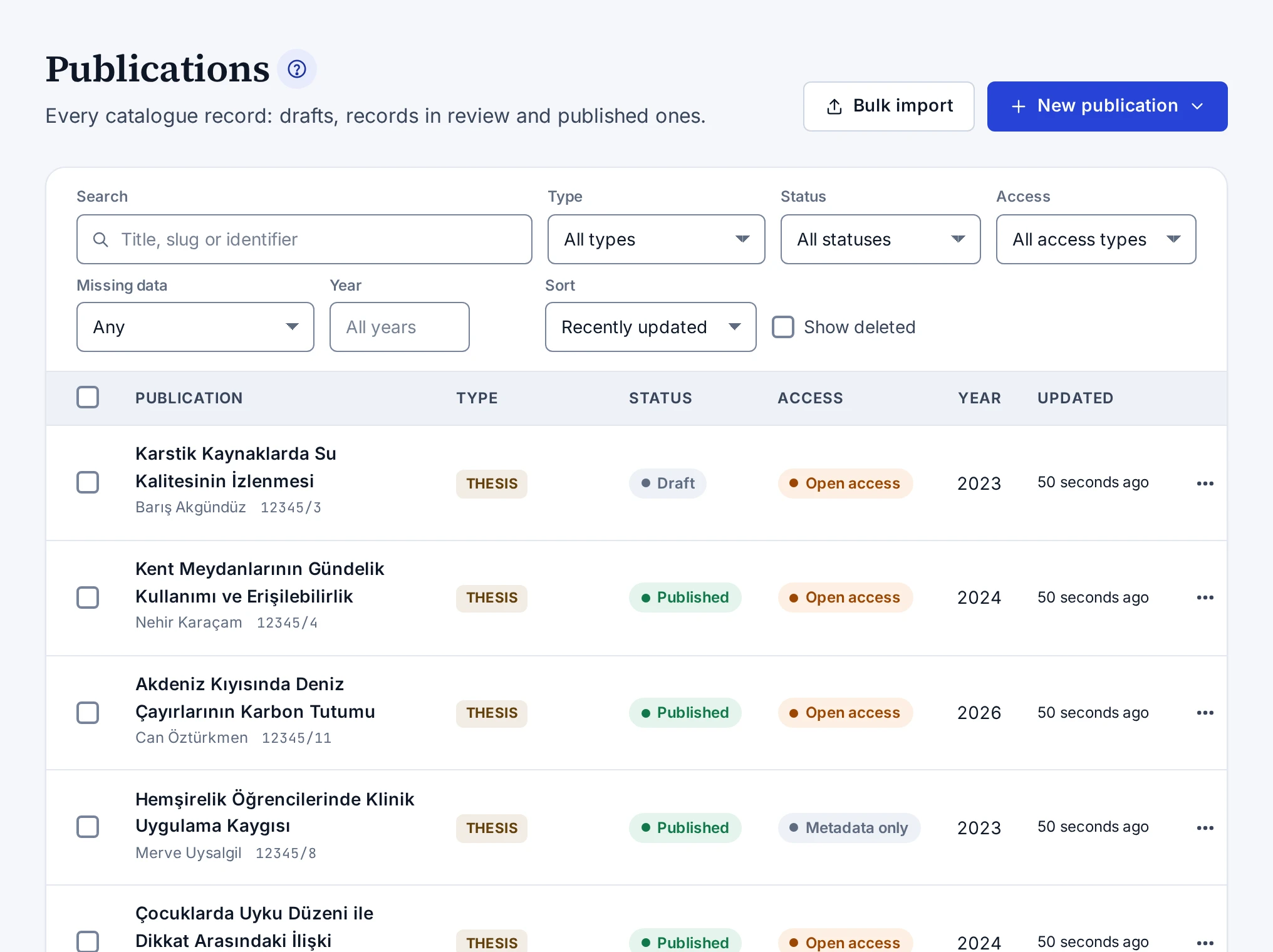
Buttons at the top
- New publication opens a new record of the type you select and needs the catalogue edit permission.
- Bulk import opens the bulk import screen and needs the bulk import permission.
Search and filters
The search box searches the record's titles and subtitles in every language and its slug. Turkish letters do not matter, and a search for "isik" also finds a draft titled "Işık". The characters % and _ are searched as they are typed, so a search for "50%" finds only titles that contain "50%". The filters are these:
| Filter | Options |
|---|---|
| Type | The seven record types |
| Status | Draft, In review, Published, Archived, Retracted |
| Access | Open access, Metadata only, Embargoed, Restricted |
| Missing data | No licence, No category, No abstract, No English translation |
| Year | A four-digit publication year |
| Sort | Recently updated, Recently added, By slug (A–Z), Year (newest first), Year (oldest first) |
| Show deleted | Records in the trash |
The filters stay in the address bar. If you share the link, the same list opens. If you come from a category's menu on the Categories screen, the list is filtered by that category.
Columns
| Column | What it shows |
|---|---|
| Publication | Title, authors and the first identifier. A missing translation, a deleted record and a record you sent for review are marked with a label |
| Type | The record's type |
| Status | The record's status |
| Access | Access status |
| Year | Publication year |
| Updated | Time of the last change |
Row menu
The menu at the end of a row shows the actions that suit the record's status:
- Edit opens the record's page.
- In draft, Submit for review and Delete appear.
- In review, Publish, Return to draft and Delete appear.
- When published, Archive and Unpublish appear.
- For public records, Open the public page opens the record's page on the public site.
- For a deleted record, only Undo delete appears.
If the editor approval rule is on in your installation and you sent the record for review, the Publish (another editor publishes it) item in the menu is disabled.
Bulk action bar
When you select rows with the boxes on the left, the bulk action bar opens above the list. The bar has the Submit for review, Publish, Return to draft, Unpublish and Archive buttons. The steps are in Bulk Actions. When you change the page or the filters, the selection is cleared.
Related topics
Screens and settings
Catalogue Record
The page of a catalogue record, its tabs, the status, quality and record information cards on the right, and the save bar.
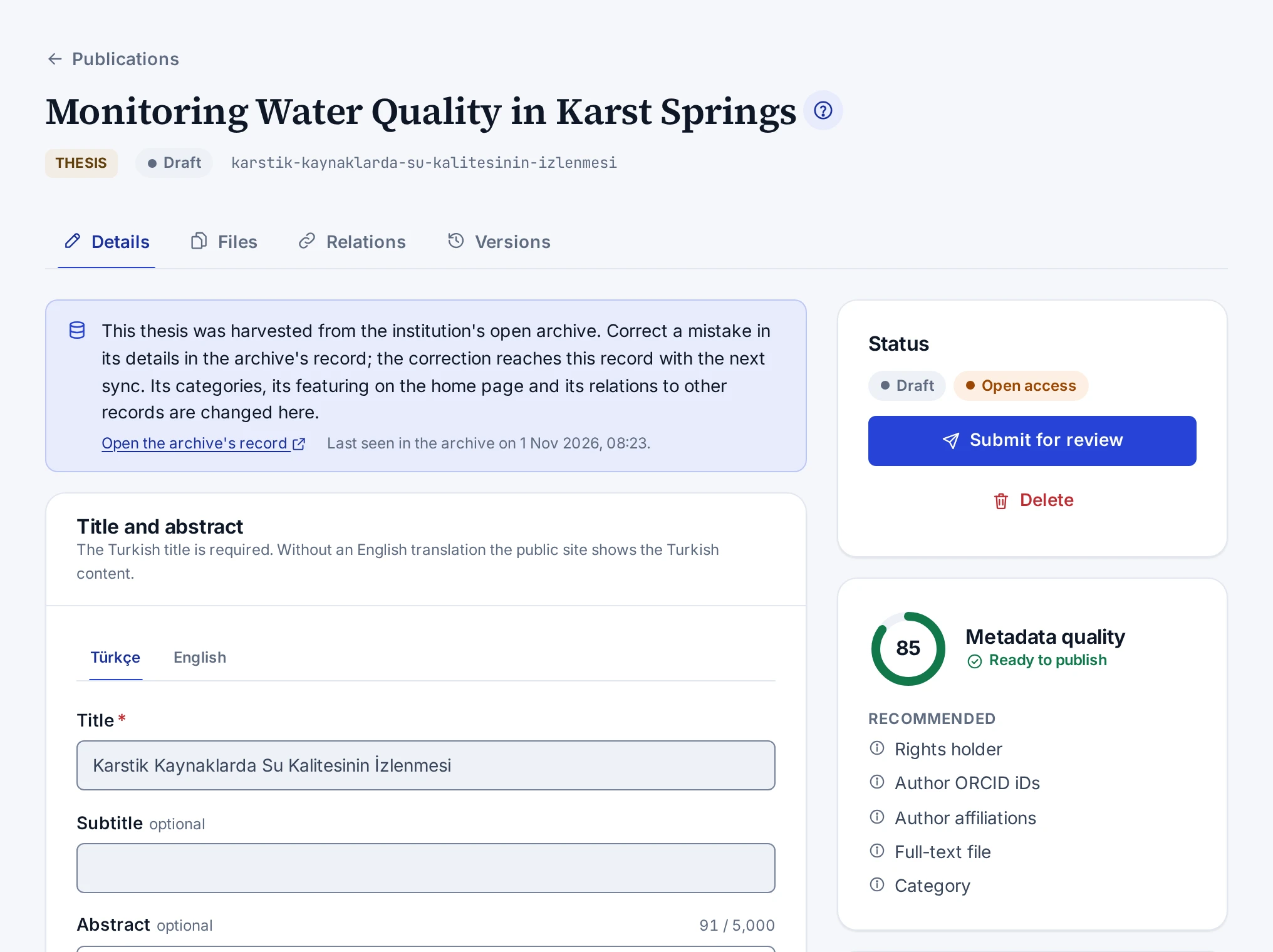
The page of a catalogue record shows all of the record's details, files, relations and versions together. You open the page by pressing the record's title in the Publications list. Next to the title you see the record's type, status, slug and any missing translation.
Tabs
| Tab | Contents |
|---|---|
| Details | Title and abstract, contributors, type-specific information, basic information, categories, identifiers, access and licence |
| Files | Full text, cover and supplementary files, the files' access and their earlier versions |
| Relations | Book and chapter, translation, supplement, new edition, correction and retraction relations |
| Versions | The record's version history, comparison and going back to an earlier version |
Cards on the right
- The Status card shows the record's status and access, the link to the public page and the actions open in that status. For a record in review it also shows who sent it for review and when.
- For a retracted or corrected record, a separate card shows the Retraction notice or Correction notice text with its date.
- The Metadata quality card shows the quality score out of 100, whether the record is ready to publish, and the Required and Recommended gaps. For articles the TR Dizin data checks warnings are here too.
- The Record information card has the time of creation, last update and first publication, the record's version number and, for an imported record, a link to the import. For the types that support it, the Download Crossref XML button and the Crossref DOI registration line are on this card too.
- On book, children's book, proceedings paper and thesis records, people with an ISBN permission see the ISBN requests card.
Save bar
When you change a field on the Details tab, a bar that says "There are unsaved changes" opens at the bottom. Save changes saves the changes, and Discard changes returns to the last saved state. The Ctrl+S shortcut (Cmd+S on a Mac) also saves. If you try to leave the page without saving, the panel asks you to confirm first.
Rules of the screen
- While there are unsaved changes, the status buttons and the Restore buttons on the Versions tab are disabled.
- While a status action runs, the other status buttons are disabled. If you press Save changes meanwhile, your changes are saved once the action is done. What you type while the action runs is not lost.
- If you have no permission to edit the catalogue, the record is view-only and a note at the top of the page says so.
- A retracted record cannot be changed. A deleted record cannot be edited until it is restored.
- On a thesis harvested from the institutional repository, a note at the top of the form says it came from the repository. The fields and files that come from the repository cannot be changed, and an earlier version cannot be restored. The categories, featuring and relations can be changed. The details are in Harvested Theses.
- If someone else changed the record while you were editing, saving stops and the "Someone else changed this record" window opens. Reload the page with Reload and make your change again.
Related topics
Screens and settings
Data Quality Screen
The filters and columns of the screen that lists catalogue records by metadata quality score, its Fix button and the CSV file.
The Catalogue → Data quality screen lists catalogue records by their metadata quality score. The record with the lowest score is at the top. You choose a problem and correct the records that have it one by one. How the score is calculated is explained in Data Quality.
Filters
| Filter | Options |
|---|---|
| Problem | The problems are listed in three groups, each with the number of records that have it. Blocks publishing, Recommended field missing, TR Dizin checks |
| Type | The seven record types |
| Status | Record statuses |
| Score | All scores, Below 80, Below 60, Below 40 |
The TR Dizin checks group appears only for articles. TR Dizin is Türkiye's national citation index.
Columns
| Column | What it shows |
|---|---|
| Publication | Title, type, status, year and authors |
| Score | Score out of 100. If the record cannot be published, Cannot be published appears below it |
| Problems | The first three problems and the number of the rest |
The Fix button on a row opens the record. If all of the record's problems concern files, the record's Files tab opens. When you correct and save the record, the score is calculated again.
CSV file
The Download CSV button downloads all rows that match the selected filters. The file has the record's ID, type, status, title, score, missing required and recommended fields, TR Dizin warnings and a link to the panel.
Rules of the screen
- The report scores the 2000 most recently changed records. When more records match the filters, a note at the top of the screen says so. Filter by type or status to see older records.
- Deleted records do not go into the report.
- The list is shown page by page, while the CSV file contains all rows.
Screens and settings
DOAB Readiness
The screen that checks books and chapters against the DOAB requirements, with its cards, its table, the gaps it checks and the template download button.
The Catalogue → DOAB readiness screen checks the books and chapters in the catalogue against the requirements of DOAB (Directory of Open Access Books). Ready records are at the top, and the others show what they lack. Ready books are downloaded in DOAB's Excel template.
Buttons at the top
- Download DOAB template downloads one XLSX file with DOAB's template, a PRISM sheet that shows the books' peer review processes and a check sheet that lists what every book lacks.
- If Also published books that are not ready is ticked, published books that are not ready also go into the template sheet.
The press's requirements
The card titled The press's requirements ticks off what DOAB expects from the press:
- A peer review process with external reviewers before publication must be defined and published on the site.
- At least three books must be ready for DOAB. Chapters do not count here.
- The address and e-mail address of the press must be on the site.
- The site must open over HTTPS.
- Editors and editorial board members must be listed on the site with their institutions. You check this line yourself.
If you have permission to manage the site settings, the card shows the Edit the peer review processes link.
Readiness count and table
The card next to it shows how many books are ready and how many records have each of the gaps that keep books out of DOAB. The table has these columns:
| Column | What it shows |
|---|---|
| Publication | Title, type, status, year and Thema codes |
| State | Ready or the number of gaps |
| Missing | What the record lacks |
| Peer review | The peer review process selected for the record |
The Fix button on a row that is not ready opens the record. If the only gap is the full text, the record's Files tab opens.
Gaps the screen checks
- The record is not published or not open access.
- There is no open licence. "All rights reserved" does not meet DOAB's terms.
- There is no public full-text PDF. This check runs only on published records.
- The book has no ISBN. A chapter goes into DOAB with its book's ISBN. That is why the book's ISBN is checked for a chapter.
- No peer review process is selected, or the process has no external review before publication.
- There is no English abstract or there are no English keywords.
- There is no Thema subject code or no publication year.
In the template, a chapter's row carries the title and the ISBN of its book. The screen checks the 2000 most recently changed books and chapters that are not deleted. The steps for preparing a book are in Preparing a Book for DOAB.
Concept
Data Quality
The metadata quality score out of 100 of a catalogue record, the required and recommended fields, and the TR Dizin data checks for articles.
Every catalogue record has a metadata quality score out of 100. The score shows how complete the record is. A record with a missing required field cannot be published. Recommended fields do not block publishing, but they help the record to be found, indexed and cited correctly.
Score calculation
Required fields make up 60 points of the score and recommended fields 40. Each missing required field lowers the score by 12. The points for recommended fields depend on the share of fields that are filled in. When you correct and save the record, the score is calculated again.
Required fields
The required fields depend on the record's type. The list for each type is in Catalogue Rules. The record's Metadata quality card lists the missing required fields under the Required heading. When nothing is missing, the card says Ready to publish.
Recommended fields
For every type, an English title, an abstract, an English abstract, keywords, a licence and a persistent identifier are recommended. For all types except journals, the rights holder, the publication year, ORCID iDs for all authors, the authors' institutions and a full-text file are recommended too. A record whose access is metadata only is not expected to have a full text.
| Type | Extra recommended fields | Expected persistent identifier |
|---|---|---|
| Book | Publisher, category, cover image | ISBN-13 |
| Children's book | Publisher, category, cover image | ISBN-13 |
| Journal | Publisher, category, cover image | ISSN or e-ISSN |
| Proceedings paper | Publisher, category | DOI or ISBN-13 |
| Thesis | Publisher, category | Handle, DOI or another identifier |
| Book chapter | No extra field | DOI or ISBN-13 |
| Article | No extra field | DOI |
TR Dizin data checks
For articles, the card also shows the TR Dizin data checks warnings. TR Dizin is Türkiye's national citation index. These warnings check details such as the English abstract, the authors' ORCID iDs and institutions, the received and accepted dates, the references, the ethics committee statement and the DOI. The warnings do not block publishing the record. If the journal makes the TR Dizin check mandatory, they block publishing the issue. The details are in Preparing for TR Dizin.
Finding the gaps
The Data Quality Screen lists the gaps in the whole catalogue by score. The Missing data filter in the Publications list also finds records with no licence, no category, no abstract or no English translation.
Concept
Four-Eyes Principle
The rule that the person who prepares a piece of work does not approve it, and the three places where JournTech applies it.
Under the four-eyes principle, the person who prepares a piece of work does not approve that same work. At least two people see each publishing decision, so fewer records are published and fewer requests are approved by mistake. JournTech applies this principle in three places.
Catalogue records
If the Catalogue records are published after an editor's approval switch on the Site settings → Workflow tab is on, a record is published only from review. The person who sent the record for review cannot publish it, and another catalogue editor publishes it. The audit log records the person who publishes as the approver.
The switch is off by default. While it is off, the person who sent the record for review can also publish it.
Releasing an accepted submission from production into the catalogue is outside this rule, because that step is already an editorial decision. Harvesting from DergiPark (Türkiye's national journal platform) and bulk import are not affected by the rule either.
Institutional content
If the Institutional content is published after review switch on the same tab is on, pages, policies and guides are published or scheduled only from review. The person who sent the content for review cannot publish it. Another editor with the publish permission publishes it.
ISBN requests
For ISBN requests the rule always applies, and no setting switches it off. A person who prepared the request, edited it after the last approval, took it back to draft or sent it for approval cannot approve the same request. The system administrator role does not carry the approval permission. An administrator who serves on the publishing board is given the Publishing board role as well.
Feature
ISBN and Legal Deposit
Preparing an ISBN request, getting the publishing board's approval, recording the application to the Ministry and following the legal deposit.
ISBNs are issued by the Yayın Standartları ve Derleme Bilgi Sistemi (the publication standards and legal deposit information system) of the Ministry of Culture and Tourism. The person authorised for your institution in the Ministry's system applies there with their own e-Devlet (Türkiye's e-government gateway) login. JournTech never sends an application on your behalf. It collects the details of the application, has the publishing board approve them, and records the Ministry steps and the number that comes back.
Requests run on the Editorial → ISBN & legal deposit screen. The Production coordinator prepares the request and the Publishing board approves it. The Ministry's form is filled in by hand from the copy sheet on the request page, or with the browser extension your institution has installed.
Once the number has been assigned, the barcode for the cover and the copyright page are prepared. When the print date is entered, the 15-day legal deposit period starts and JournTech follows the legal deposit steps. Reminders go out for upcoming and overdue tasks. The whole process is described in ISBN Process.
Screens and settings
ISBN & Legal Deposit Screen
The status filters, search, columns, upcoming obligations card and yearly report card of the screen that lists ISBN requests.
The Editorial → ISBN & legal deposit screen tracks ISBN requests, the publishing board's approval, the steps at the Ministry of Culture and Tourism, printings and legal deposit (derleme) in one place.
Status filters
The buttons above the list filter the requests by status and show the number of requests in each status. You can select several statuses at once.
| Status | Meaning |
|---|---|
| Draft | The data for the Ministry form is being filled in |
| Awaiting approval | The request is waiting for the publishing board's approval |
| Ready to apply | The approved request is waiting to be entered in the Ministry's system |
| Sent to the Ministry | The application is made and the number is awaited |
| ISBN assigned | The number is entered and the book is not printed yet |
| Printed | The print date is entered and the legal deposit period is running |
| Deposit complete | The legal deposit steps of every printing are complete |
| Cancelled | The request was cancelled |
Search and filters
- The Search box searches titles, application numbers and ISBNs. For an ISBN, type at least 4 digits.
- The Form list filters requests by the forms Print, PDF, EPUB and Other.
- The Year of request field filters by the year in which the request was opened.
The filters stay in the address bar.
Columns
| Column | Shows |
|---|---|
| Title | The title. Set and volume requests are marked. |
| Form | Print, PDF, EPUB or other |
| Edition | The edition number |
| Status | The status of the request |
| ISBN | The assigned number |
| Planned date | The planned print or publication date |
| Updated | The time of the last change |
Side cards
The Upcoming and overdue obligations card lists approvals, Ministry steps, print dates, and bandrol (banderole) and legal deposit deadlines by due date. Overdue items are at the top, and each row opens its request. The Yearly report (Excel) card downloads the workbook for the selected year.
New request
The New ISBN request button is shown to the people who handle ISBN requests. The steps are in Preparing an ISBN Request.
Screens and settings
ISBN Request Page
The status line, warnings, action buttons and the form, copy sheet, printings, barcode, copyright page and history cards on the page of an ISBN request.
The header of the request page shows the title, the status, the form and edition, the assigned ISBN and the application number at the Ministry of Culture and Tourism. The line below the header gives the next step and who takes it. On a request linked to a catalogue record, the Catalogue record button opens the record.
Warnings
The warnings at the top of the page show these situations.
- The publishing board sent the request back, or the Ministry returned the application, with a reason.
- The request was cancelled.
- No publisher certificate is entered, or it has expired.
- No Ministry officers are listed.
- The ISBN range message has not been fetched yet.
- The ISBN range message has not been refreshed for more than three weeks and does not know the number of the request.
Action buttons
Which buttons appear depends on the status of the request and on your permissions.
| Button | Request status | Who uses it |
|---|---|---|
| Send for approval | Draft | Production coordinator |
| Approve, Send back | Awaiting approval | Publishing board |
| Back to draft | Awaiting approval, Ready to apply | Production coordinator |
| Sent to the Ministry, Fill with the extension | Ready to apply | Ministry officer |
| Enter the ISBN, Ministry returned it | Sent to the Ministry | Ministry officer |
| Add volume | Set request | Production coordinator |
| Cancel request | Before a print date is entered | Production coordinator |
| Delete | Draft | Production coordinator |
If a button you expect is missing, the reason is shown below the buttons. For example, if you prepared the request, it says that another member of the publishing board has to approve it.
Cards
| Card | What it shows |
|---|---|
| Data for the Ministry form | The data the Ministry form asks for. The card can be edited only while the request is a draft. |
| Copy sheet for the Ministry form | The fields of the Ministry form in the form's order, each with a copy button |
| Printings and legal deposit | The date, bandrol (banderole) and legal deposit steps of each printing. The card appears once the ISBN is assigned. |
| Barcode and copyright page | The EAN-13 barcode and the copyright page. The card appears once the ISBN is assigned. |
| History | Every action on the request, who took it and when |
| Request details | Who prepared the request, sent it for approval and approved it, the board decision, who sent it to the Ministry, the application number and who entered the ISBN |
| Volumes | The volumes of a set, or the set of a volume |
For an electronic publication, the printings card is called Publication and EYDeS. The order of the cards depends on the status of the request. For example, on a request that is ready to apply, the copy sheet moves above the form.
The whole process is described in ISBN Process.
How-to
Approving an ISBN Request
How the publishing board reviews an ISBN request awaiting approval and approves it with the decision date and number, or sends it back with a reason.
When a request becomes Awaiting approval, it comes to the members of the Publishing board for approval. After 3 business days, the board gets a reminder about a request that is still awaiting approval.
Approving
- On the Editorial → ISBN & legal deposit screen, filter the requests awaiting approval with the Awaiting approval button.
- Open the request and review the details on the Data for the Ministry form card.
- Press Approve.
- Optionally fill in Date of the board’s decision and Decision number. They appear on the copyright page (künye), and the decision date cannot be in the future.
- Optionally enter a Note.
- Press Approve in the dialog.
The request becomes Ready to apply. The Ministry officer then applies at the Ministry of Culture and Tourism with their own e-Devlet login (Türkiye's e-government gateway). The board approves the request in the state in which it reviewed it. If the request changed while you were reviewing it, the approval is not saved. The panel says that the record has changed, and the Reload button opens the latest state of the request.
Sending back
- Press Send back.
- In What has to change?, enter a reason of at least 5 characters and confirm.
The request returns to draft. The person who prepared it sees the reason in the warning at the top of the request, corrects the form and sends it for approval again.
Four-eyes principle
Whoever prepared the request, edited it since the last approval, took it back to draft or sent it for approval cannot approve the same request. In that case the Approve button is hidden and a note gives the reason. The System administrator role does not carry the approval permission. An administrator who sits on the board is also given the Publishing board role. The reasoning behind the rule is in Four-Eyes Principle.
How-to
Downloading the Barcode and Copyright Page
Downloading the cover barcode of a book with an ISBN as SVG or PDF, and copying the text of the copyright page or getting it as a PDF.
Once a request has its ISBN, the Barcode and copyright page card prepares the EAN-13 barcode for the cover and the book's copyright page (künye).
Barcode
- On the request's Barcode and copyright page card, press Download SVG or Download PDF.
- Give the file to the cover designer.
The barcode is at its nominal size and takes up about 37 × 32 mm. Do not shrink it.
Copyright page
- Check the text in the Copyright page section of the card.
- Copy the text with Copy the copyright page, or download the copyright page as a PDF with the Download PDF button next to it.
The copyright page contains the following.
- The title and subtitle, the authors and the contributors
- The publisher's name and publisher certificate number
- The date and number of the publishing board's decision
- The ISBN and the numbers of the other forms of the same edition
- The edition and printing details, the printer and the printer's certificate number
- The place and year of publication
- The licence statement for an openly licensed book, and the copyright line for other books
The publisher's details come from Site settings, and the edition, printing and printer details from the request.
Hyphenation
The hyphens in the number are placed according to the range message of the International ISBN Agency. If the range message has not been fetched yet, the barcode and the copyright page show the 13 digits of the number without hyphens, and the card says so in a warning. The same happens when the message has not been refreshed for more than three weeks and does not know the number. This way a number split in the wrong places is never printed. Before sending the book to print, wait for the range message to be fetched or refreshed, or set the hyphens by hand as the screen of the Ministry of Culture and Tourism shows them.
How-to
Downloading the Yearly ISBN Report
Downloading the ISBN requests, numbers, Ministry dates and the legal deposit steps of each printing for a chosen year as an Excel workbook.
The yearly report gives the ISBN requests and legal deposit (derleme) steps of a year in one Excel workbook.
- On the Yearly report (Excel) card at the side of the Editorial → ISBN & legal deposit screen, select the year in the Year list.
- Press the download button of the card. The label of the button includes the year you selected.
The report contains the requests that were not cancelled. A request is in the report when it was opened or given a number in the selected year, or when one of its printings was printed in that year. Each printing is a separate row and appears in the report of the year it was printed. A reprint of a book whose request was opened in an earlier year is therefore in the report of the year of the reprint. A printing without a print date appears in the report of the year the request was opened or given its number. A request with no printing in the year is a single row, with the printing columns empty. The columns are as follows.
| Column | Content |
|---|---|
| ISBN, Eser adı, Biçim, Baskı, Durum | The details of the request (title, form, edition, status) |
| Başvuru no, Başvuru tarihi, ISBN tarihi | The steps at the Ministry of Culture and Tourism (application number, application date, ISBN date) |
| Basım no, Basım tarihi, Bandrol | The details of the printing (printing number, print date, bandrol) |
| Derleme gönderildi, EYDeS, Ajans nüshası, Derleme tamam | The dates of the legal deposit steps (copies sent, EYDeS, agency copy, deposit complete) |
Cells whose value starts with =, +, - or @ are written as text and do not work as formulas in Excel.
Concept
ISBN Process
The statuses an ISBN request goes through from draft to legal deposit, who takes each step, and the part JournTech plays in the Ministry application.
ISBNs are assigned by the Yayın Standartları ve Derleme Bilgi Sistemi (the publication standards and legal deposit information system, ekygm.gov.tr) of the Ministry of Culture and Tourism. The Ministry offers no public service that other systems can connect to. So the person authorised for your institution in the Ministry's system applies with their own e-Devlet login (Türkiye's e-government gateway). JournTech collects the data for the application and has the request approved. It records the Ministry steps and the number that comes back, tracks the printing and the legal deposit (derleme), and sends reminders before deadlines pass. JournTech never sends an application on your behalf.
The path of a request
| Status | What happens | Who does it |
|---|---|---|
| Draft | The data for the Ministry form is filled in. | Production coordinator |
| Awaiting approval | The request goes to the publishing board. | The Publishing board approves it or sends it back with a reason. |
| Ready to apply | The approved request is entered in the Ministry's system. | Ministry officer |
| Sent to the Ministry | The application number is recorded. The Ministry usually assigns the number the same day. | Ministry officer |
| ISBN assigned | The number is checked and written to the catalogue record. The barcode and the copyright page are ready. | Ministry officer |
| Printed | Entering the print date starts the 15-day legal deposit period. | Production coordinator |
| Deposit complete | All legal deposit steps are ticked. | Production coordinator |
| Cancelled | The request, or a number that will not be used, is cancelled. | Production coordinator |
If the publishing board sends the request back or the Ministry returns the application, the request returns to draft with the reason and goes for approval again. When the print date of a reprint with the same ISBN is entered, the request becomes Printed again, and it is complete again once the legal deposit of that printing is done.
Ministry officer
A Ministry officer is a person who acts for the institution in the Ministry's system. If officers are listed in the site settings, only they record the Ministry steps. If the list is empty, the Production coordinator who handles ISBN requests records these steps too. The list is described in Entering the Publisher Settings.
Approval and the four-eyes principle
The Ministry application is made in the institution's name, and the number it brings is written to the catalogue record. That is why the person who prepared a request does not approve it, and another member of the publishing board gives the approval. The rule is described in Four-Eyes Principle.
Legal deposit
Within 15 days of printing, six copies of a printed book with bandrols (the banderole stickers issued by the Ministry) are delivered to the deposit office, and its electronic copy is uploaded to EYDeS, the electronic legal deposit system. For e-books, legal deposit is through EYDeS only. The steps are in Tracking Legal Deposit.
Screens and settings
ISBN Reminders
Which events in the ISBN and legal deposit process send a reminder, when and to whom, and where the reminder days are changed.
The Upcoming and overdue obligations list on the ISBN & legal deposit screen shows all open tasks by deadline. Reminders go out for the same tasks, as panel notifications and e-mails. The e-mails do not contain the title of the book, only the date and a link.
Default reminders
| Event | When | To whom |
|---|---|---|
| The publisher certificate is about to expire | 90, 30 and 7 days before, then weekly once it has expired | System administrators and production coordinators |
| A Ministry officer's account was closed | Monthly | System administrators |
| A request is awaiting approval | After 3 business days | Publishing board |
| An approved request was not entered at the Ministry | After 3 business days | Ministry officers |
| Sent to the Ministry, no number entered | After 1 business day | Ministry officers |
| The print date is approaching | 14 and 3 days before | The preparer and the Ministry officers |
| The print date has passed and no printing is entered | The next day | The preparer and the Ministry officers |
| No bandrol (banderole) application yet | 21 days before printing | The preparer |
| Legal deposit steps are missing | 10 and 14 days after printing | The preparer |
| The legal deposit period has passed | Weekly from day 16 | The preparer and the publishing board |
| Weekly digest | Monday | Production coordinators and Ministry officers |
Business days are counted from Monday to Friday. Public holidays are not left out: a holiday on a weekday counts as a business day. If no Ministry officers are listed, the reminders meant for the officers go to the production coordinators. The weekly digest goes out only when something is upcoming or overdue. If the e-mail of an e-mail template is switched off, only the panel notification goes out.
Changing the days
A System administrator changes the days on the Reminders card of the Site settings → Publisher and ISBN tab. For the reminders counted in business days and for the bandrol reminder, 0 switches the reminder off. The 15-day legal deposit period set by law does not change. The settings are described in Entering the Publisher Settings.
Troubleshooting
The Approve button is missing on an ISBN request
Causes related to the four-eyes principle, the request's status and the role when a publishing board member cannot see the Approve button on an ISBN request.
The Approve button appears only to people with the Publishing board role, and only on a request that is awaiting approval. Check the causes below in order.
You prepared or edited the request
Whoever prepared the request, edited it since the last approval, took it back to draft or sent it for approval cannot approve the same request. In that case the Send back button appears, the approve button does not, and a note gives the reason. Another member of the publishing board gives the approval. The reasoning behind the rule is in Four-Eyes Principle.
The request is not awaiting approval
If the request was taken back to draft or has been approved, the button is hidden. The status of the request is shown in the page header.
You do not have the role
The System administrator role does not carry the approval permission. An administrator who sits on the board is also given the Publishing board role. The steps for granting a role are in Granting and Revoking Roles.